Here is my poster for the DRAKKAR 2026 meeting.
Abstract
Sea ice is a solid plate floating on top of the polar oceans. The movement of sea ice is highly variable both in time and space, characterized by largefluctuating velocities superimposed to the mean velocity. The properties of fluctuating velocities cannot be fully explained as a simple response to the atmospheric and oceanic turbulence as it is much more intermittent. To understand the dynamical properties of the fluctuating velocities, we study the kinematic energy using Lagrangian statistics derived from observed trajectories, inspired by classical multi-scale analysis from fluid turbulence. We used winter trajectories from the International Arctic Buoy Program (IABP) in the sea-ice-covered central Arctic Ocean. Based on these trajectories, we compute a variety of diagnostics, both Lagrangian and Eulerian, which reveal the complexity of sea-ice dynamics. In particular, the eulerian energy spectra is found to follow a -2 scaling on the 10 to 1000\,km wavelength range, which differs from the ocean both in term of scaling and in term of general shape. Towards a complete characterisation of the sea ice dynamics across scales, we propose a phenomenological model that describes the across scale repartition of mechanical and kinematic energy. Energy is injected at multiple scales through atmospheric and oceanic stress, and gets directly retransfered across scales by stress concentration along the fractures in sea ice. Elastic energy is eventually transformed into kinetic energy, which is in part dissipated by coulombic friction along the fractures, and in other part transmitted into the ocean. Sea ice acts as an energy filter that redistributes energy across scales. Accurate parameterisation of the rheology is thus necessary in models so that the energy input to the ocean is at proper scale.
Poster
Don’t hesitate to contact me if you have any questions or if you want to discuss with me.
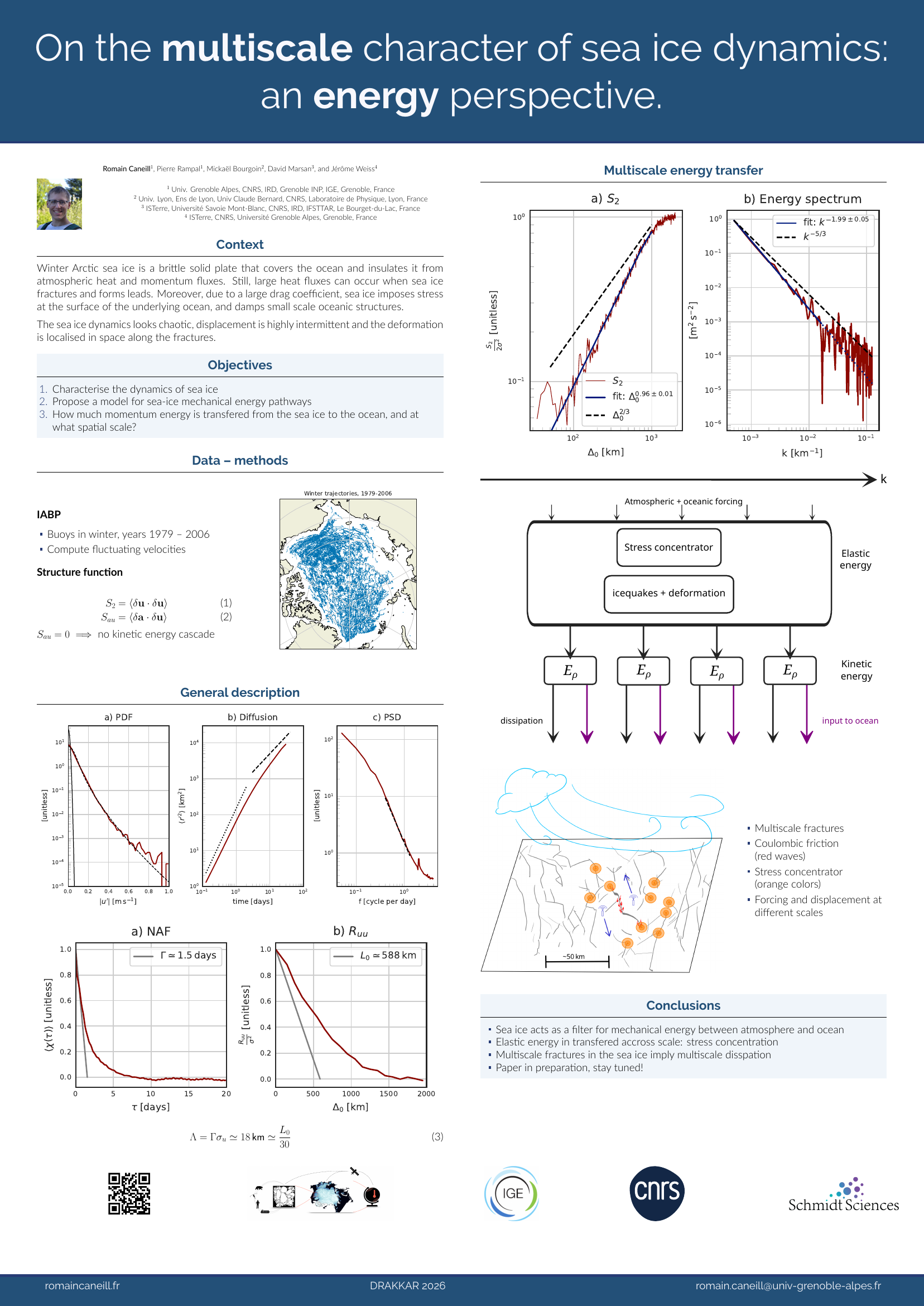
Click on the picture to access the pdf version.